
A CONVERSATION BETWEEN KERRY KENNEDY AND CHRIS MATTHEWS - LESSONS FROM BOBBY - TEN REASONS ROBERT F. KENNEDY STILL MATTERS

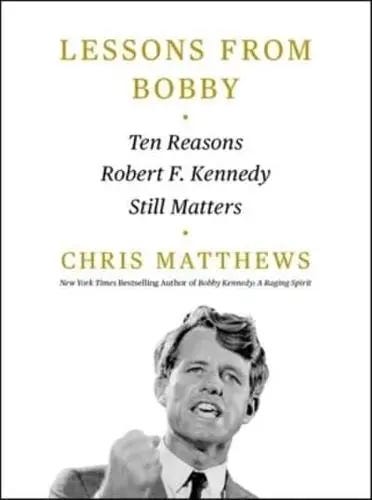
This past Friday, the day after what would have been Robert F. Kennedy’s 100th birthday, journalist Chris Matthews joined Kerry Kennedy with the Robert F. Kennedy Human Rights organization discussing his new book, Lessons From Bobby - Ten Reasons Robert F. Kennedy Still Matters.
“So many people say that he changed so much,” says Kerry Kennedy. “Do you see that as an evolution or do you see that as a dramatic moment, the result of his brother’s death?”
“The issue that some people turn to as really determinant in terms of his development,” says Matthews, “was when he sent John Siegenthaler, his administrative assistant when he was Attorney General, to join the Freedom Riders heading into Alabama in 1961. Siegenthaler was attacked, and when he said he was from the federal government, that’s when they really went after him. They hammered his head with some sort of metal object. And he’s lying on the ground bleeding, and the local cops just said, ‘Let him lie there.’ And he was lying there for about a half hour and finally they picked him up and took him to the hospital. That’s when Harry Belafonte and John Lewis said, ‘That was the awakening of Bobby Kennedy.’ When somebody close to him, a personal friend, an associate, got beat up by that white crowd Bobby recognized that he was up against evil and that he had to take it on. So some of it was experiential, evolutionary, seeing the white angry crowds in the South, seeing the courage of the Freedom Riders, but it evolved, so by 1968 Bobby was ready to take on the reality of life. Bobby developed over time to be a person who somehow felt the suffering of the people whose rights were being denied and everybody said that about him. He was not some limousine liberal pretending to be concerned. He somehow felt the horrible depression of minorities. He developed with experience into a guy who really cared. And it was real.”
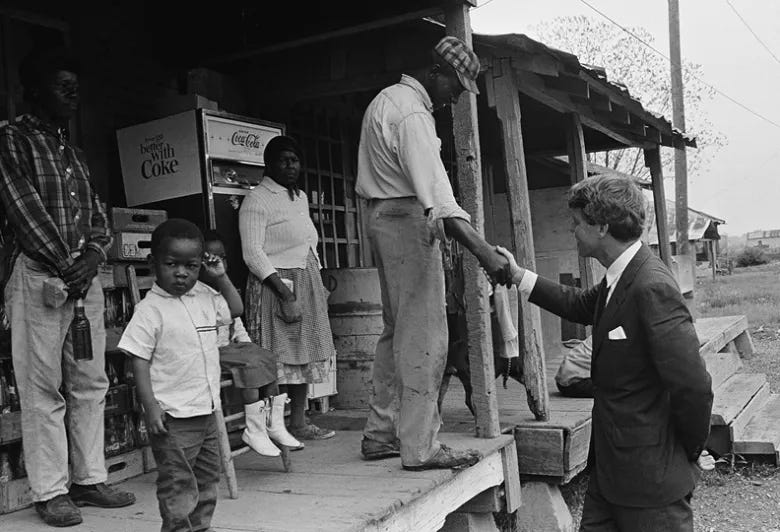
Interestingly, Kerry Kennedy disagrees with Matthews regarding some of his observations, suggesting that when Harry Belafonte and also Martin Luther King, Jr. first recognized Robert F. Kennedy as a potential vehicle for their cause they didn’t really know him. They just admired the toughness they had seen on television when he fought the unions and took on Jimmy Hoffa. They liked that he was aggressive and single-minded, but she explains that he had a much deeper history than that. He did change and he did evolve, “but he was the scrawniest little brother of these big hulking handsome guys who got a lot of attention,” says Kennedy. “Since he was a little kid he had always been on the side of the bullies.” He was fortunate to be aligned with his brothers, although he grew up recognizing the plight of those that were less fortunate. “When he was in college he refused, and got the rest of the football squad to refuse to stay at hotels which wouldn’t allow the black kids on the squad to stay with them. He invited Ralph Bunche to speak at the University of Virginia which was not fully integrated at that time.” Bobby Kennedy insisted that UVA desegregate in response to Bunche’s visit. “Chuck Greenfield, who was Kennedy’s aide once said, ‘You could wrap up his life in the phrase, ‘Get your boot off his neck.’ As soon as he saw someone who was being bullied,” says Kerry Kennedy, “he was on the side of the bullied person.” When Robert Kennedy was invited to appear at the University of Georgia in 1961, he purposely spoke on behalf of the school’s first two Black students, Charlayne Hunter and Hamilton Holmes who had been greeted with riots outside of their dorms upon arrival. Charlayne Hunter-Gault later said, “What I always found amazing was that he was, in fact, invited for Law Day and it was the law students who had organized the riot outside my dorm.” Bobby Kennedy addressed the situation in his speech with a direct message to those involved.
“Is there a story about Robert Kennedy, big or small, that you think captures who he really was behind the scenes?” asks Kerry Kennedy.
“How he came up as a kid,” says Matthews. “I think that turned him in the direction of looking out for people. When his brother was killed, Chuck Spalding told the story of going over to the Lincoln Bedroom in the White House, and listening to Bobby on the other side of the door, basically praying at the same time he was complaining, and he was saying, ‘Why when things were going so well would this happen? How could this happen?’ He couldn’t connect it with his beliefs. It didn’t make any sense to him what had happened in Dallas. I think a lot of that was still working out in his head by 1968 when King was killed. How do you rectify, justify horror when you’re doing the right thing, when your life is all aimed at the right thing and all of a sudden the worst thing in the world happens? I think that explains a lot about him, how he had to adjust, which he was still trying to do at the 1964 Democratic National Convention in Atlantic City where he sat out on the fire escape after he gave that incredible speech about Jack. He’s out on the fire escape crying because of the situation he was in which was talking about his dead brother, and how that could have happened? And, of course, he was still unable to say what happened in Dallas. He referred to it as a member of his family being killed several years before and he’s talking about Jack. It was very hard for him to say the words. My life was changed completely by Jack being killed,” says Matthews. “I can only imagine what it would have been like to have devoted your life to him as Bobby did and to have it all thrown away.”
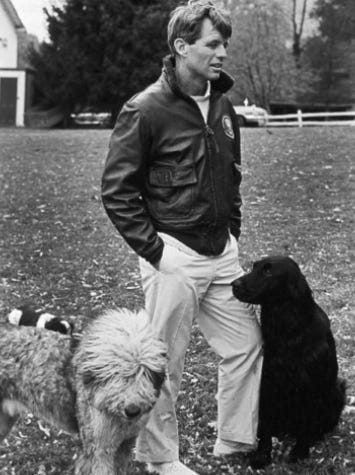
“Daddy lost his best friend and his partner,” says Kerry Kennedy countering the perspective that Matthews contributed. “They were really partners in such a profound way. Of course, Jack was the president, but they really worked hand in hand together over all the big issues. When Jack died it was his brother, his partner, a man who knew him best whose sentences he could complete. But it was his job, and the jobs of everybody around him. I mean, everybody lost their job on the same day. That has a profound impact, especially on men, especially in the 1960s. What are you going to do? The country, and you personally? What is going to happen to your family? It’s not just you, it’s everybody you know. So, it was a colossal event. The thing that my mother said when my father was asked about this, about his change, he said, ‘You know, I’ve always worked for someone else.” Kennedy shares that her father had probably been confined, always trying to advance someone else, and then suddenly he was free. “My mother said that he was kind of released. After Jack died, he said, ‘I’m just going to go out and represent the people who I know are suffering the most in this country and around the world.”
Kerry Kennedy changed the focus to her father’s monumental trip to South Africa in 1966. “He didn’t need to go to South Africa,” says Kennedy. “Most Americans had never heard of apartheid, but he was asked by Ian Robertson, and he went and he gave that extraordinary speech on democracy and on change and the capacity of the individual to make a difference.” Ian Robertson was a 21-year-old student who invited Bobby Kennedy to speak in South Africa leading to Kennedy’s famous “Ripple of Hope” speech at the University of Cape Town. Robertson was not at the speech. He had been banned by the government and, instead, was represented by an empty chair.
In response to Kerry Kennedy’s story, Matthews reflects on his own time in South Africa with the Peace Corps first in 1968 and then again in 1971. “It was still apartheid,” he says. “There was no television. They thought television would liberate the country and they didn’t want that. It’s a strange society because part of it was highly sophisticated. Dr. Christian Barnard was doing heart transplants. At the same time they were monitoring and policing interracial relations. They didn’t want any kind of integration going on - morality laws, they called them. It was a conflicted society and what Bobby did when he came in was give his speech which sounded like he was talking about South Africa but he was really talking about America, about a country settled by the Dutch and overrun by the British. Eventually the country became independent but it still had racial troubles and he said, ‘I’m talking of course about the United States. Every country has to solve its own history in its own way, so I’m not here to dictate. But individuals can make a difference.’ The idea being that individuals can step forward whether it’s Thomas Jefferson or people fighting against Nazis in Europe in the 1940s. People still talk about it over there,” says Matthews referring to Kennedy’s famous “Ripple of Hope” speech.
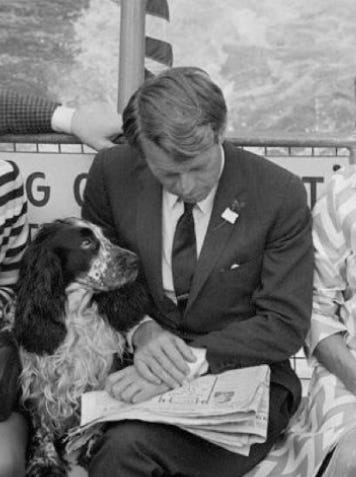
An audience member asks, “RFK made audiences uncomfortable with his candor and his challenges to complacency. He never pandered. Could he be elected in today’s political environment?
“Nothing works today,” says Matthews. “It’s on both sides. You turn on MSNOW, formerly MSNBC, and the answers to all the questions are, ‘I agree with you completely.’ There’s no discussion, no nuance of difference. CNN is a little different. They sometimes have Republicans on. Then you go to full pander on the other side, where people do not turn on the news to learn the news. They turn on the news to have their feelings and thoughts confirmed. The reason they watch the news is to confirm their opinions. They act like they’re getting news. They don’t want news. They don’t want a conflict. They don’t want a discussion.” Kerry Kennedy asks, “Where can people go for actual news?” Matthews says, “C-SPAN, PBS, and NPR sometimes. I remember Walter Cronkite was a liberal, but he didn’t advertise it. People don’t want to hear any discordance. We’re a very shaky society right now. I hope we can have a really good election in ‘28 with what I would call a moderate Democrat, a governor of some kind, and have a real election. I’d like to see a real Nixon-Kennedy election that’s somewhere near the center but I don’t know if it’s in the prospects right now.”
A second member of the audience asks, How does Senator Robert Kennedy’s legacy still matter today?
“If you want a great country, we should try our best to be a good country,” says Matthews. “I think if you go through the whole line of what Bobby did, helping his brother get elected president, really fighting for civil rights, avoiding a nuclear war, and then eventually coming out against the Vietnam War in a way that made perfect sense. You can always do the right thing, and we can do the right thing. We’ve got to end that war in Ukraine, we’ve got to end that war pretty soon. What’s going on in Kiev is horrible, the bombing is terrible, and we have to find a way to end it. And to truly end the Middle East war between Israel and Gaza. There should be a full effort by our President, the leader of the world, to end those wars and stop dilly-dallying about it because people are getting killed every day. I think we should be the world leader we used to be, when Eisenhower and Kennedy were the world leaders, and Reagan, too. I think we should go back to being the leader.”
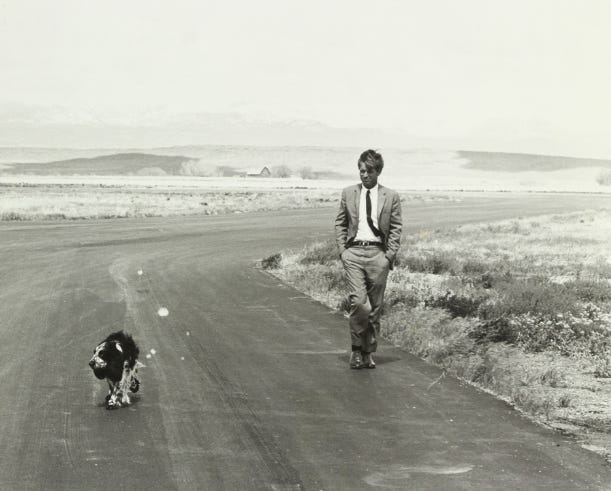
“RFK Human Rights has fifty people working there, and I would say all but ten of them are between 20 and 40 years old,” says Kerry Kennedy, setting up a final question for Matthews. “They are mostly trying to stop governments from abusing rights in our country and around the world. What are two or three things that you would want them to know about Bobby Kennedy as they are carrying forward his unfinished work? What is it that they need to know about him?”
“Unity, trying to heal the divisions in the country,” says Matthews, “and certainly, he managed to unite working class white people, Black people, Hispanic people, and American Indians - American Indigenous people. That was all real and one didn’t seem to come out against the other. It wasn’t like his concern for Blacks and Hispanics in California offended white people. He found a way to unite the sides. I think courage is another thing, I just think simple guts. We have to have a democracy in our country before we talk about anything in the rest of the world. We need to have an independent Senate and an independent U.S. House of Representatives. We have to have people willing to stand up and not just be robots, robots for this president where on a Sunday morning they are against disclosing files on Epstein and Sunday night they switch depending on what the president wants them to do. The willingness to accept mistakes is another big part of Bobby. Hanging a lantern on your problem, he called it. The willingness to go out and say, I wasn’t so great about civil rights growing up, but now I’m into it and I believe in it, and I’ve changed. Vietnam is another case. He was always in the process of growing, of learning." George McGovern once said of RFK, “He gradually became more and more a critic of the war. It was personally very difficult for him, very painful for him to reverse course on that issue.” “And the last one, you’ve got to admit when you lose an election,” says Matthews. “The Oregon primary was a heartbreaker, but Bobby went right out in front of the public and said, I lost. Gene McCarthy beat me. Pat Buchanan told me he was in the audience and he said that was the greatest speech. Buchanan said Kennedy looked better in defeat than he would have in victory. And I think that is an essential part of what we are. If we can’t be truly democratic and support defeat, we don’t have much to say to the rest of the world.”
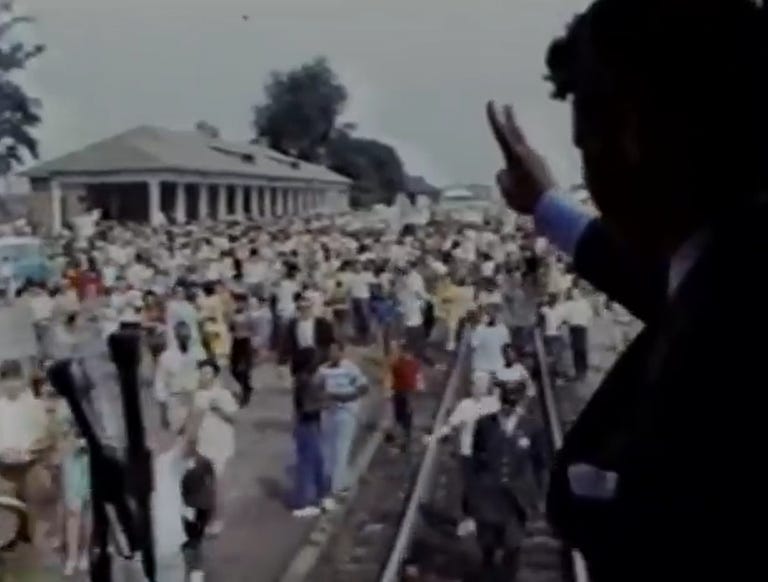
Robert F. Kennedy’s influence cuts straight through today’s politics with a continued message about listening, learning, growing, and having the moral courage to stand up to adversity, political and otherwise, characteristics that Chris Matthews reminds us are in great demand in today’s bitterly divided political culture.
Not to mention a political legacy so lasting and personal it can be identified by just saying Bobby.
If you like my articles, please hit the “LIKE” button. It will help to let me know that you are enjoying my writing.
I welcome and invite you to COMMENT.
And please SHARE these posts! This gives added support to my Substack page and also helps to add new readers.
Thanks so much to anyone who is reading Journeys with Jay!